
Fueling the Driverless Revolution
The advent of driverless vehicles will usher in a new age in road-based transportation. Developing and implementing the technology will likely require the industry to relax intellectual property rights somewhat in order to standardize safety and security features. Increased governmental regulation may be necessary to ensure public safety. There is a strong economic incentive driving unmanned self-piloting delivery vehicles, from pizza delivery to 18-wheelers. Saliently, the industry and society will have to cope with a transition period of many years during which mixed vehicle technologies will share the roadways.
This blog envisions a future in which few cars are privately owned and the automotive industry functions primarily as a provider of autonomous vehicle transportation services. Driver liability and insurance issues are examined in that light. Applications to law enforcement and private security are discussed.
“Before anything else, preparation is the key to success.” – Alexander Graham Bell
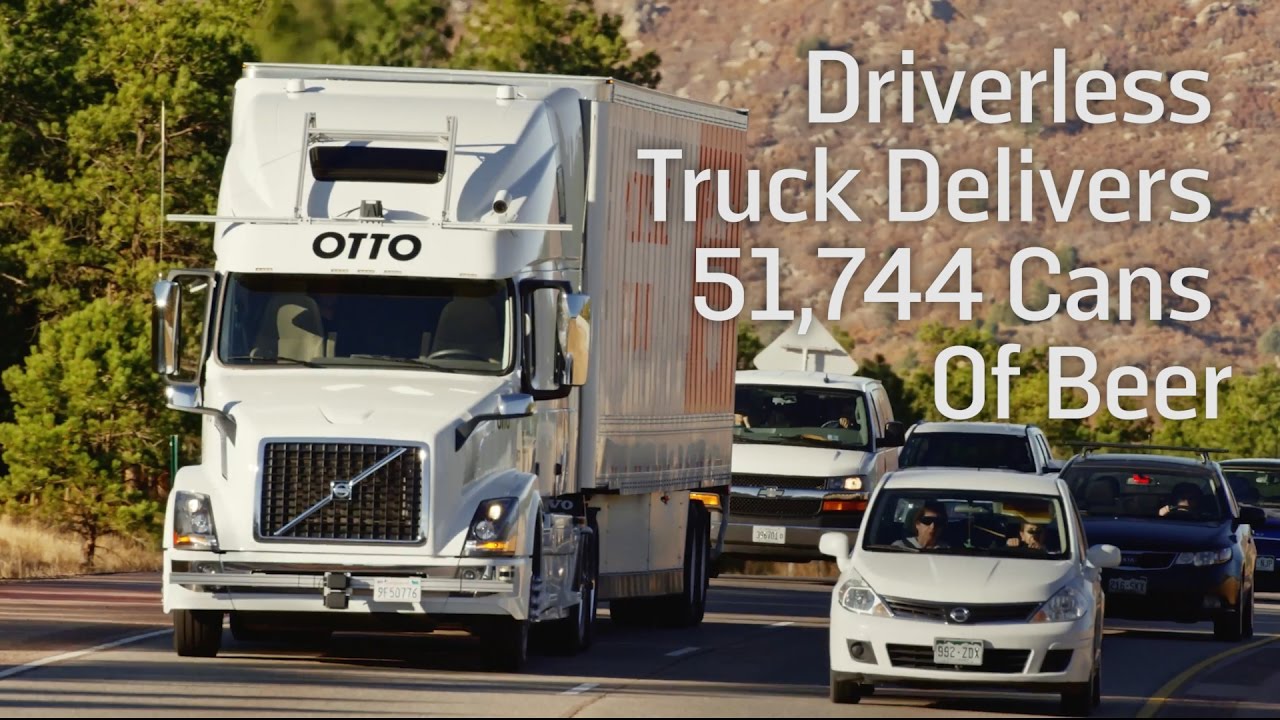
Self-driving freight trucks offer obvious safety and efficiency advantages over human-driven trucks, and will likely provide the some of the initial inroads for this technology, which is enabled in part by 5G wireless protocols developed for telecommunications.
INTELLECTUAL PROPERTY RIGHTS VERSUS PUBLIC SAFETY
The development and implementation of autonomous vehicle technology will generate critical intellectual property issues, primarily around the software algorithms and sensor systems that will replace human judgment, perception and attention. Fundamentally, the degree to which such systems can be patented or kept as trade secrets is debatable. Some aspects of self-driving automotive technology clearly are patentable. For example, Ford has patented an “Autonomous vehicle entertainment system” for displaying movies on the windshield of a self-driving vehicle while it chauffeurs passengers (U.S. Patent No. 9,272,708 filed Sept. 30, 2013).
The fact that thousands of U.S. patents have already issued on technologies such as Adaptive Cruise Control, Anti-Collision Systems, and Vehicle Steering Systems would seem to signal the willingness of the USPTO to allow claims of appropriate scope.[1]
But even if the subject matter is patentable, corporations may prefer to maintain their algorithms and sensor systems as trade secrets to secure the competitive advantage of being first to market and/or offering superior product features. Other companies might decide not to enforce their patent rights on the theory that a rising tide lifts all boats.[2]
With the advent of self-driving cars, however, the legacy free market model collides with public safety concerns that have led the federal auto safety regulators to set machinery in motion to ensure proper testing and regulation of the new technology.[3] Automotive corporations will be called upon to share test data and coded algorithms so that the safety of the new products can be independently verified. A federal safety registration or certification program will likely be necessary. A combination of patent and trade secret protection with regulation of safety-related features comports with the historical automotive industry model.
[1] Ashlee Vance, Why Elon Musk Just Opened Tesla’s Patents to His Biggest Rivals, Bloomberg, June 12, 2014, https://www.bloomberg.com/news/articles/2014-06-12/why-elon-musk-just-opened-teslas-patents-to-his-biggest-rivals.
[2] Rahul Vijh, Autonomous Cars – Patents and Perspectives, IP Watchdog, Apr. 7, 2016, http://www.ipwatchdog.com/2016/04/07/autonomous-cars-patents-perspectives/id=68045/.
[3] Joan Lowy and Justin Pritchard, Feds preview rules of the road for self-driving cars, Associated Press, Sept. 19, 2016, http://bigstory.ap.org/article/ce6dbb62c0904d29ac969c50e1220c8c/feds-want-regulate-drivers-when-driver-car.%5BA%5D; US Department of Transportation, Secretary Foxx Unveils President Obama’s FY17 Budget Proposal of Nearly $4 Billion for Automated Vehicles and Announces DOT Initiatives to Accelerate Vehicle Safety Innovations, Jan. 14, 2016, https://www.transportation.gov/briefing-room/secretary-foxx-unveils-president-obama%E2%80%99s-fy17-budget-proposal-nearly-4-billion.%5BB%5D
NEXT UP: THE CASE FOR AN INDUSTRY CONSORTIUM
There are viable and arguably superior alternatives to relying solely on the federal government to ensure public safety. In the automotive industry those alternatives align pubic interests more closely with corporate interests than, for instance, in the financial industry. An unstable financial system can at least temporarily be shrouded in fraudulent security ratings and obscure derivative funds. The automotive industry, on the other hand, would be immediately crippled if official traffic statistics reflected a poor safety record for self-driven cars.
Despite (or perhaps because of) the recent international Volkswagen diesel emissions scandal,[4] reputable and self-interested corporations should recognize that a good faith effort to produce safe self-driven vehicles is essential for their very survival. Automotive corporations may also perceive mutual benefit in collaborating on the testing and standardization of algorithms, sensor systems, and vehicle-to-vehicle communication protocols prerequisite to widespread implementation of self-driving vehicles. . . .
[4] Jack Ewing and Hiroko Tabuchi, Volkswagen Scandal Reaches All the Way to the Top, Lawsuits Say, The New York Times, Jul. 19, 2016.

